
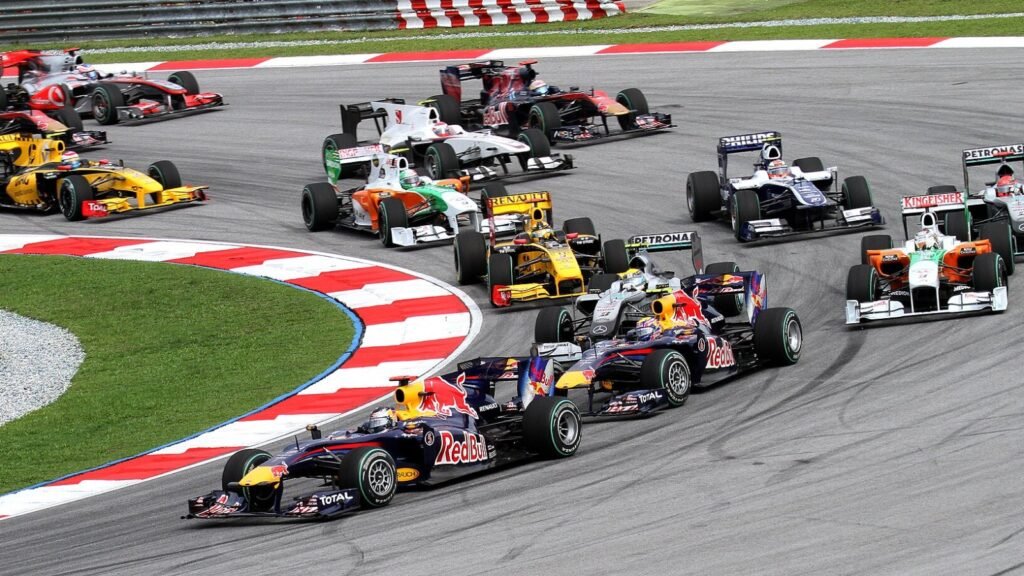
A Formula 1 car cornering at speed is doing something that appears to defy the limits of rubber and asphalt. The explanation is not exotic tyre compounds alone. It is air. At racing speed, the airflow over and under the car generates a downward force several times the car’s own weight, and that force is what makes the cornering speeds possible.
Downforce is an upside-down wing
An aircraft wing is shaped so that air travelling over it produces lower pressure above than below, and the pressure difference lifts the aircraft. A racing car uses the same principle inverted. Its wings and floor are shaped to create lower pressure underneath than above, pressing the car towards the track.
Related: how VAR decisions are made
Extra vertical load increases the friction available at the contact patch, which allows higher cornering, braking and traction limits. Crucially, this load is generated by the car’s own motion, so it grows with speed. A car that feels ordinary in a slow hairpin becomes extraordinary in a fast sweeping corner, because the downforce available there is far higher.
The floor does most of the work
Front and rear wings are the visible aerodynamic elements, but on a modern car the floor generates the majority of total downforce. Contoured channels beneath the car accelerate air through a narrowing section and then expand it again in a diffuser at the rear. Accelerating air lowers its pressure; the low-pressure region under the floor effectively sucks the car towards the ground.
This is ground effect, and it is highly efficient because it produces enormous downforce without the drag penalty of a large wing. It is also highly sensitive. The effect depends on the gap between floor and track, so ride height, pitch under braking and roll in corners all change how much downforce the car makes. Run the floor too low and the airflow can stall abruptly, causing a sudden loss of grip and the violent vertical oscillation known as porpoising.
Related: how EV batteries degrade over time
Drag: the unavoidable cost
Every aerodynamic surface that generates downforce also generates drag, the resistance opposing forward motion. Drag consumes engine power and limits top speed. Car setup is therefore a trade-off decided by circuit character: a track dominated by long straights rewards a low-drag, low-downforce configuration, while a circuit of tight, connected corners rewards maximum downforce even at the cost of straight-line speed.
Engineers speak of aerodynamic efficiency, the ratio of downforce to drag. The design goal is not simply more downforce but more downforce per unit of drag, which is why so much development effort goes into small surfaces that condition airflow rather than into ever-larger wings.
Managing the wake
Air does not flow cleanly around a shape as complicated as a racing car. Rotating, exposed wheels generate particularly disruptive turbulence. A large part of aerodynamic design consists of managing where that turbulence goes: directing wheel wake outboard and away from the floor, sealing the floor edges so the low-pressure region underneath is not contaminated, and feeding clean air to the rear wing and diffuser.
This is why front wings are so intricate. Their job is only partly to generate front downforce; they also set up the airflow structures that the rest of the car depends on. A small change at the front can have effects several metres downstream.
Dirty air and the following problem
The air behind a car is turbulent, slower and lower in energy than undisturbed air. A car following closely therefore has less clean airflow to work with and loses a significant fraction of its downforce, most severely at the front. The result is understeer, tyre overheating from sliding, and an inability to stay close through the corner that precedes an overtaking opportunity.
Regulations have been rewritten specifically to address this. Emphasising floor-generated ground effect over complex upper-body surfaces, and simplifying front wings, produces a wake that is directed upwards and over a following car rather than outwards into its path. Following remains harder than running in clear air, but the design intent of modern rules is to reduce that penalty rather than to reduce downforce overall.
Adjustable aerodynamics
Because the following problem cannot be eliminated by geometry alone, the sport also uses a driver-activated device that opens a flap in the rear wing within designated zones, temporarily reducing drag and raising top speed. It is a blunt instrument, and opinions on it are divided, but it exists because aerodynamic wake makes natural overtaking difficult.
Why it is never finished
Aerodynamic development is continuous because the returns are so large. A gain measured in a small percentage of downforce translates into lap time at every corner of every circuit. Teams pursue it through computational fluid dynamics simulations and scale-model wind tunnel testing, both of which are now restricted by regulation, with the least successful teams granted more development time in an attempt to compress the field.
Understanding the aerodynamics changes how a race looks. A driver struggling to follow through a fast corner and then attacking into the braking zone is not simply being cautious. They are managing a car that has temporarily lost a large share of the invisible force holding it to the road.
More from PressBBC
- How VAR Decisions Are Made, and Why They Still Cause Arguments
- The Science of Marathon Pacing: Why the Wall Happens and How to Avoid It
- Electric Vehicle Batteries: Chemistry, Range and What Degradation Really Looks Like
- Browse everything in our Sport section.
Sources and further reading
- FIA — Formula 1 Regulations — the technical rules that shape every car
- Formula 1 — official race and technical explainers