Vaccine development is frequently discussed as a single event: a vaccine either exists or it does not. In practice it is a long sequence of tests, each designed to answer a different question, with the majority of candidates failing somewhere along the way. Understanding what each stage checks makes it easier to interpret claims about safety and effectiveness.
Discovery and preclinical work
The first task is choosing what the immune system should be trained to recognise. Researchers identify a component of the pathogen, often a surface protein, that antibodies can bind to and that does not vary so rapidly that immunity becomes useless. The chosen approach might involve an inactivated pathogen, a weakened live version, a purified protein, a viral vector, or genetic instructions that prompt the body to manufacture the target protein itself.
Related: what “ultra-processed” actually means
Candidates are then assessed in cell cultures and animal models, looking at whether an immune response is generated, whether that response protects against challenge with the pathogen, and whether there are signs of toxicity. Most candidates never leave this stage. Those that do must also be manufacturable consistently at scale, which is a separate and frequently underestimated hurdle.
Phase one: safety and dose
The first human trials involve a small group, typically a few dozen healthy adult volunteers. The purpose is not to prove the vaccine works but to establish that it is tolerated and to explore dose. Researchers measure side effects, monitor for unexpected reactions, and take blood samples to see whether the expected immune response appears and at what dose.
Trials generally begin at a low dose and escalate cautiously, with review points between groups. The immune measurements at this stage are indirect indicators, not proof of protection.
Related: how a bill becomes law in the UK Parliament
Phase two: response and schedule
If the candidate passes, it moves to several hundred participants, chosen to reflect the intended population more closely: a broader age range, and often people with common underlying conditions. This stage refines the dose, tests the interval between doses, and gathers substantially more safety data.
Phase two is also where less common side effects begin to become visible, simply because more people have been exposed. Trials are frequently randomised and blinded from this point, with a control group receiving either a placebo or an established vaccine.
Phase three: does it actually prevent disease
The decisive stage typically enrols many thousands of participants, sometimes tens of thousands, randomly assigned to receive the vaccine or a control. Neither participants nor investigators know who received what. The trial then waits for illness to occur naturally in the community.
Efficacy is calculated by comparing disease rates in the two groups. A figure often quoted as a percentage describes the relative reduction in risk among vaccinated participants compared with the control group. It does not mean a given proportion of people are protected and the rest are not, which is one of the most persistent misreadings of trial results.
Trials also specify in advance what outcome is being measured. Preventing any infection, preventing symptomatic illness and preventing severe disease or hospitalisation are different endpoints, and a vaccine can perform very differently against each. Comparing headline figures across trials that measured different endpoints, in different populations, at different times, is unreliable.
Phase three is where rare adverse events start to become detectable, though events occurring in fewer than one in ten thousand people may still be invisible at this scale.
Regulatory review
A manufacturer submits the full data package to a national or regional regulator, which conducts an independent assessment rather than accepting the company’s analysis. Reviewers examine raw trial data, manufacturing processes, quality control, consistency between production batches, and stability. Independent advisory committees frequently review the evidence in public session.
Approval is a judgement that benefits outweigh risks for a defined population and use. It comes with conditions: approved age groups, dosing schedule, contraindications, and obligations for continued study.
Phase four: monitoring after approval
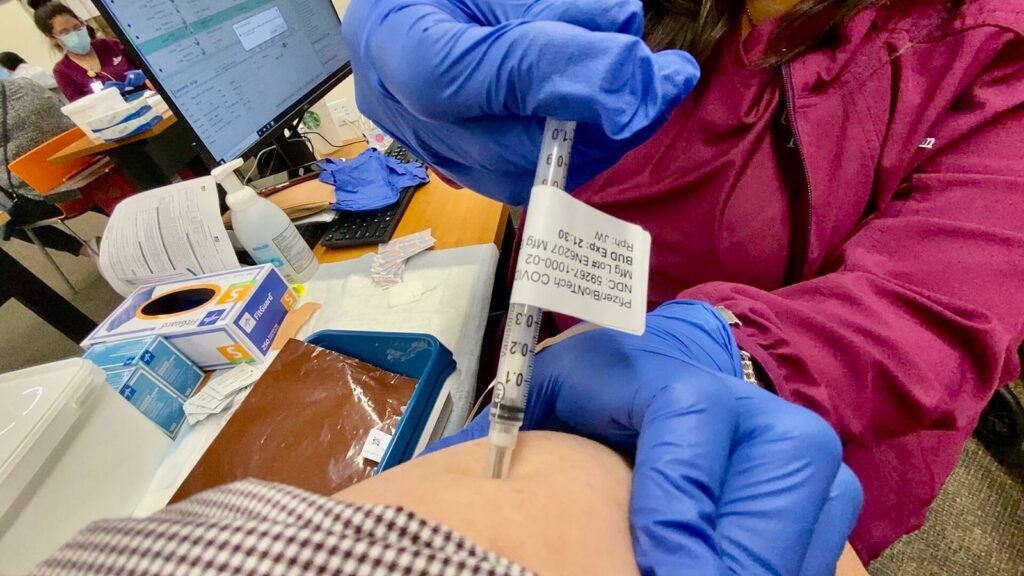
Surveillance after rollout is where very rare effects are identified, because the exposed population becomes far larger than any trial. Systems combine mandatory reporting by healthcare professionals, voluntary reporting by patients, and active monitoring of health databases comparing observed rates of conditions against expected background rates.
Reporting systems capture events reported after vaccination, not events proven to be caused by it. Establishing causation requires comparing observed rates against what would have occurred anyway. This distinction is routinely lost when raw report counts are quoted as though they were confirmed harms. When genuine signals do emerge, the response has historically been to restrict use in affected groups or update guidance, which is the system functioning as designed.
Why rapid development is not the same as skipped steps
Accelerated timelines have generally come from compressing waiting time rather than removing tests. Trial phases can be run in overlapping sequence rather than strictly one after another, regulators can review data continuously as it is generated rather than in a single submission at the end, and manufacturing can be scaled up at financial risk before approval is granted so that doses exist if authorisation follows.
Each of these removes delay without removing evidence. The number of participants, the endpoints measured and the regulatory standard applied remain the questions worth asking about any specific vaccine.
This article is general information and not a substitute for advice from a qualified healthcare professional.
More from PressBBC
- Ultra-Processed Food: What the Term Means and What the Evidence Shows
- Sleep Debt: What the Research Actually Says About Catching Up
- How a Bill Becomes Law in the UK Parliament
- Browse everything in our Health section.
Sources and further reading
- World Health Organization — global standards for vaccine evaluation
- MHRA — the UK regulator that authorises vaccines
- FDA — Vaccines — the US approval pathway and published review documents